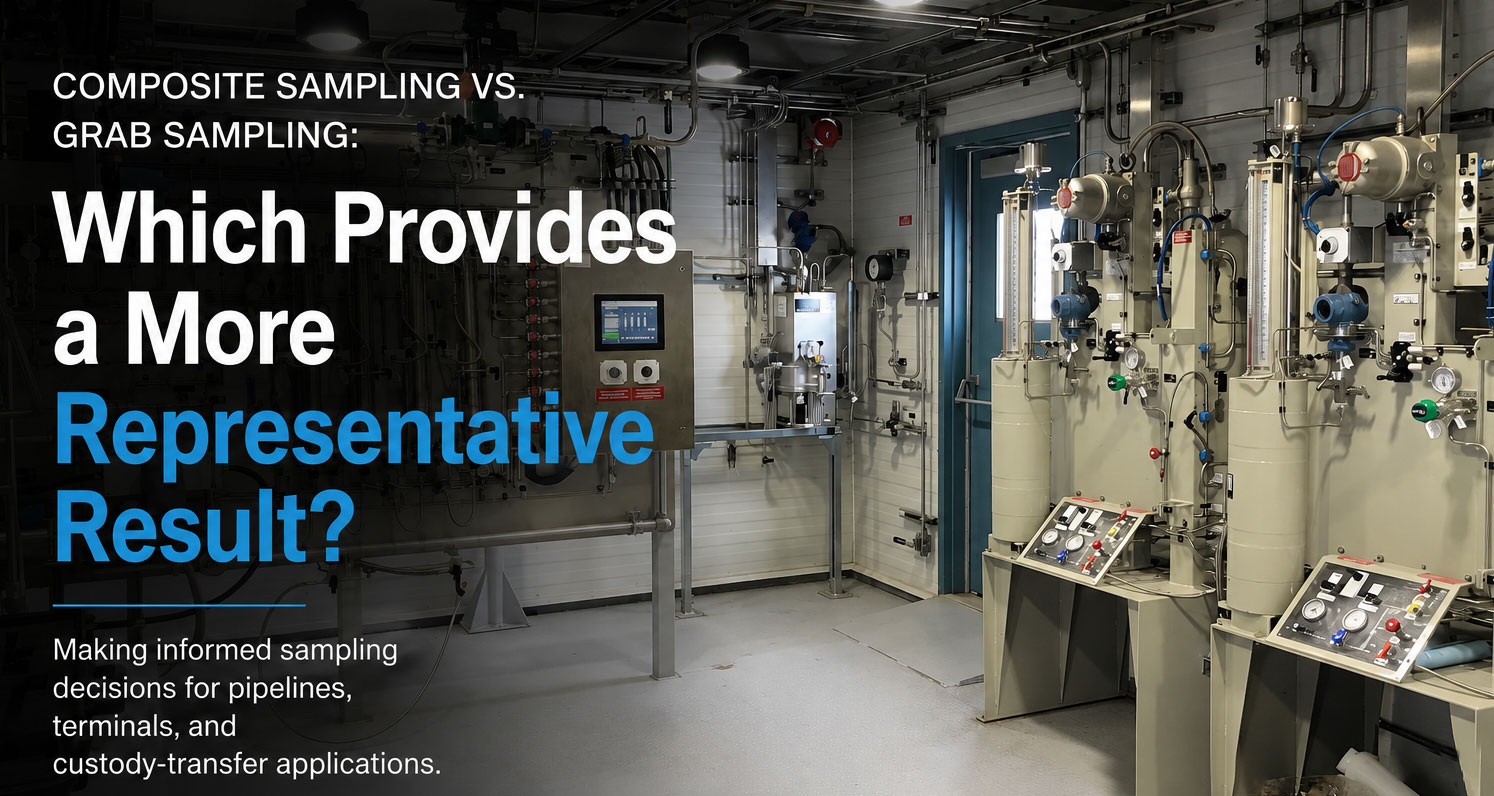
When comparing composite sampling vs. grab sampling, the most important question is not which method is universally better. It is which method provides a sample that accurately represents the material and operating period being evaluated.
A grab sample captures process conditions at a particular moment. That can be useful for troubleshooting, verification, and spot checks. However, when liquid hydrocarbon quality changes throughout a transfer, one isolated sample may not represent the complete volume.
Composite sampling addresses this limitation by collecting multiple sample increments over a defined period. When the sampling system is properly designed and operated, the combined sample can provide a more representative assessment of the liquid hydrocarbons transferred through a pipeline, terminal, production facility, or custody-transfer system.
What Is the Difference Between Composite Sampling and Grab Sampling?
A grab sample is collected from a process stream at a specific point in time. It provides a snapshot of the product present at the sampling location when the sample is taken.
A composite sample is created by collecting a series of smaller sample increments throughout a transfer or operating period. Those increments are combined in a sample receiver and later analyzed as one representative sample.
The difference is the period each method is intended to represent:
- Grab sampling helps answer: “What was the product like at this moment?”
- Composite sampling helps answer: “What was the overall quality of the product transferred during this period?”
This distinction becomes increasingly important when composition or product quality may change during a transfer.
Why a Single Grab Sample May Not Represent the Complete Transfer
Liquid hydrocarbon properties are not always constant from the beginning of a transfer to the end. Variability can be introduced by changes in the incoming product, tank conditions, flow rate, mixing, water content, sediment, or transitions between operating conditions.
For example, a grab sample collected during a stable portion of the transfer may miss a temporary change in product quality. Conversely, a sample collected during a brief upset may make the entire transfer appear less consistent than it actually was.
Potential sources of variation include:
- Changes in the producing source or incoming batch
- Tank stratification or incomplete mixing
- Transitions between products
- Changes in pipeline flow rate
- Water or sediment moving unevenly through the stream
- Startup, shutdown, or line-displacement conditions
- Changes in pressure or temperature
A laboratory may analyze the sample it receives accurately, but the laboratory result can only characterize the material contained in the sample container. It cannot correct a sample that did not adequately represent the process stream or transfer.
How Composite Sampling Provides a More Representative Result
Composite sampling reduces dependence on one isolated collection time by taking multiple sample increments throughout the transfer.
Depending on the process and system design, sample collection may be initiated according to elapsed time, transferred volume, flow rate, or another defined operating signal. The appropriate approach depends on the transfer profile, expected product variability, applicable procedures, and the purpose of the analysis.
Collecting multiple increments helps incorporate product from different stages of the transfer into one sample. This can provide a more balanced representation of the overall transferred volume, particularly when process conditions are not completely stable.
Composite sampling can also improve repeatability by applying a defined sampling procedure from one transfer to the next. This reduces dependence on when an operator happens to be available to collect a manual sample.
When Is Composite Sampling More Representative Than Grab Sampling?
When Product Quality Changes During the Transfer
Composite sampling is particularly valuable when properties such as density, water content, sediment, sulfur, composition, or volatility may vary during the transfer.
A sample made up of increments collected over time is less dependent on the product conditions that existed during one specific moment.
When the Transfer Takes Place Over an Extended Period
The longer a transfer continues, the greater the opportunity for feed conditions, product quality, or operating conditions to change.
A grab sample collected near the beginning or end of a long transfer may not adequately represent the material transferred during the intervening hours. A composite sample can include material collected throughout the operating period.
When Flow Rate Changes
Many transfers do not operate at one constant flow rate. Startup, normal operation, slowdowns, and shutdown can all affect throughput.
When the objective is to represent the transferred volume, the sampling method should account for the transfer profile. A properly configured sampling strategy helps prevent portions of the transfer from being overrepresented or underrepresented in the final sample.
When the Result Has Commercial Significance
In custody-transfer applications, laboratory results may be used to verify product quality, investigate discrepancies, support reconciliation, or assess compliance with commercial terms.
If the sample represents only one brief moment from a much longer transfer, questions may arise about whether the reported result accurately reflects the complete product movement.
Composite sampling supports greater custody-transfer confidence by providing the laboratory with a sample collected across the defined transfer period rather than relying exclusively on an isolated grab.
When Repeatable Collection Is Required
Manual sampling may be influenced by differences in timing, technique, sampling location, container preparation, and sample handling.
An automated composite sampling system applies a defined collection sequence throughout the transfer. This can improve consistency between transfers and make the sampling process easier to document, review, and repeat.
Does Composite Sampling Replace Grab Sampling?
Composite and grab sampling serve different purposes, and many facilities benefit from having access to both methods.
Grab sampling is generally appropriate for:
- Checking current process conditions
- Investigating a process upset
- Confirming an unexpected analyzer result
- Collecting a sample from a specific point in a batch
- Performing maintenance or validation checks
- Obtaining an independent spot sample
Composite sampling is generally more appropriate for:
- Representing an extended transfer period
- Evaluating average product quality over time
- Supporting pipeline and terminal operations
- Supporting custody-transfer quality assessment
- Reducing dependence on the timing of a single sample
- Applying a repeatable collection method between transfers
An automatic composite sampler may be used to collect the transfer sample, while a dedicated grab sampling system remains available for troubleshooting, verification, and targeted sample collection.
A Composite Sample Is Not Automatically Representative
Collecting multiple sample increments does not, by itself, guarantee a representative result. The complete sampling system must be designed around the process, product properties, operating conditions, and analytical requirements.
Important design and operating considerations include:
Sampling Location
The sample should be extracted from a location where the flowing stream is adequately mixed and representative of the product being transferred. A poorly selected sample point can introduce bias before the sample enters the collection system.
Sample Probe Design
Probe position, orientation, insertion depth, and extraction geometry can influence the material entering the sampler. The probe must be selected and installed for the specific pipe configuration and process conditions.
Sampling Frequency
The sampling sequence must collect enough increments to represent the expected variability and duration of the transfer. Too few increments may leave significant portions of the transfer inadequately represented.
Proportionality
The relationship between sample collection and product flow should be considered, especially when the transfer experiences significant changes in throughput.
Sample Integrity
Pressure, temperature, volatility, and phase behaviour must be considered so that the collected sample does not change before analysis. Loss of light components, flashing, contamination, or phase separation can affect the result.
Sample Receiver Selection
The receiver must be compatible with the product, operating pressure, expected sample volume, and laboratory handling procedure.
Mixing and Handling
The collected composite may require an appropriate mixing and transfer procedure before a laboratory portion is removed. Poor handling can compromise a sample that was collected correctly.
System Verification
The sampler should be tested and monitored to confirm that sample increments are being collected and retained as intended.
Industry practices such as ASTM D4177 address the design, installation, operation, testing, and monitoring of automatic petroleum sampling systems. ISO 3171 provides guidance for the automatic pipeline sampling of crude oil and liquid petroleum products.
The applicable standards, contractual requirements, sampling procedures, and regulatory obligations should be confirmed for each installation.
How Representative Sampling Supports Custody-Transfer Confidence
Custody transfer involves more than measuring the quantity of product moving through a pipeline or loading system. Product quality can also affect how a transfer is evaluated and reconciled.
A representative sample provides a stronger basis for determining the physical and chemical properties assigned to the transferred product. This can help reduce uncertainty when results are used for:
- Product quality verification
- Water and sediment assessment
- Batch or transfer reconciliation
- Investigation of quality disputes
- Confirmation of commercial specifications
- Laboratory reporting and documentation
Composite sampling does not replace accurate flow measurement, correct laboratory procedures, or clearly defined custody-transfer agreements. It strengthens the quality assessment process by helping ensure that the submitted sample represents the transfer period being evaluated.
The Insight Composite Sampler
The Insight Composite Sampler is designed for the automatic collection of multiple samples over a defined period, supporting consistent and representative sample collection in liquid hydrocarbon applications.
The system can be configured for pipeline and custody-transfer installations, including integration with LACT units and applications involving volatile liquids. Pressurized and non-pressurized configurations are available to accommodate different process and sample-receiver requirements.
Key capabilities include:
- Automated sample collection over a defined period
- Programmable sampling intervals
- Pressurized and non-pressurized configurations
- Integration with LACT units
- Customizable system design
- CRN-certified configurations
- Stainless-steel construction for industrial environments
- Simplified operation using clearly identified valves and instructions
Because representative sampling depends on more than the collection device, Insight Analytical can also support the surrounding sample system design and integration. This can include application review, sample extraction, engineering, fabrication, controls, documentation, testing, commissioning, and ongoing technical support.
Is Composite Sampling Appropriate for Your Application?
Composite sampling is most valuable when the objective is to determine the overall quality of a product transferred over time rather than the conditions present at one isolated moment.
Before selecting a sampling system, consider:
- The liquid being sampled
- Expected composition and quality variability
- Normal and minimum flow rates
- Transfer duration
- Operating pressure and temperature
- Sample point location and stream mixing
- Required laboratory analyses
- Sample receiver requirements
- Applicable standards and commercial agreements
A review of these conditions can help determine whether composite sampling, grab sampling, or a combination of both methods is most appropriate.
Explore the Insight Composite Sampler to learn more about available configurations and applications.
For assistance evaluating a pipeline, terminal, LACT, production, or custody-transfer sampling application, contact Insight Analytical.