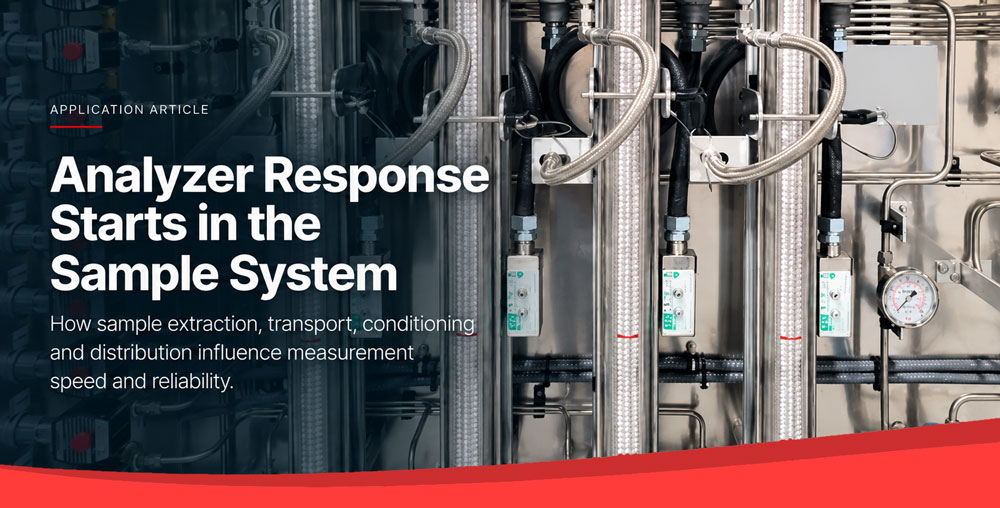
When an analyzer is slow to respond, unstable, or difficult to trust, the analyzer itself often receives the blame. But the performance of an analyzer sample system can have just as much influence on the final measurement.
Between the process and the analyzer, that sample may travel through a probe, tubing, filters, regulators, valves, distribution components and other conditioning equipment. Every part of that path can influence how quickly a process change reaches the analyzer and whether the sample remains representative along the way.
For many process analyzer applications, improving measurement performance therefore starts with evaluating the complete sample system, not simply the analyzer specification.
Why Analyzer Sample System Design Affects Response Time
Analyzer response time is only one part of the total measurement response.
Imagine that a process composition changes at 10:00:00. Even if the analyzer itself can respond within seconds, the analyzer cannot detect that change until the new sample has travelled from the process connection through the entire sampling system.
If that journey takes two minutes, the measurement is already two minutes behind the process before analyzer response time is even considered.
In practical terms, total response depends on several stages:
Process change → Sample extraction → Sample transport → Conditioning → Distribution → Analyzer response
This is why installing a faster analyzer does not necessarily produce faster process information.
1. Transport Lag: How Long Does the Sample Take to Get There?
Transport lag is one of the most important factors in analyzer system response.
The sample must physically move through the tubing between the process and the analyzer. The time required depends on factors including:
- tubing length
- tubing internal diameter
- sample flow rate
- operating pressure
- gas density and compressibility
- the volume of components installed in the flow path
A long sample line operating at a relatively low flow rate can introduce substantial delay.
The relationship is straightforward: the larger the volume that must be displaced and the lower the flow through that volume, the longer it takes for a process change to reach the analyzer.
Increasing flow can reduce transport time, but simply increasing flow everywhere is not always practical. Pressure drop, filtration requirements, venting capacity and analyzer flow limitations all have to be considered.
One common approach is a fast loop, where a higher sample flow is maintained through the transport portion of the system while a smaller controlled flow is supplied to the analyzer.
Insight's FSS-1 Fast Sample System is designed around reducing internal volume and integrating filtration, pressure control and sample handling into a compact assembly to support rapid gas sample delivery.
Explore the FSS-1 Fast Sample System
2. Dead Volume: Small Spaces Can Create Large Delays
Not all sample-system volume contributes equally to useful flow.
Dead volume refers to areas in the sample system where flow is limited and the sample is not fully refreshed by the main stream. This can occur in:
- oversized fittings
- valve cavities
- unused branches
- tees and manifolds
- poorly designed regulators
- filters
- long connections to gauges or other devices
- unnecessary tubing runs
When the process composition changes, residual sample in these low-flow areas can mix with the fresh sample entering the system.
Instead of seeing a sharp change in composition, the analyzer may see the measurement gradually transition from the old condition to the new one.
This can make an otherwise responsive analyzer appear sluggish.
More Components Are Not Always Better
Sample systems need filtration, pressure regulation, flow control, isolation and other functions.
The goal is not to eliminate those functions. It is to accomplish them while avoiding unnecessary internal volume and connections.
Compact flow paths and properly selected components can help reduce the amount of sample that must be exchanged before the analyzer sees the new process condition.
3. Filtration Can Protect the Analyzer and Affect Response
Filtration is essential in many analyzer applications.
Particulates and entrained liquids can damage regulators, restrict small passages and contaminate sensitive analytical equipment.
But filtration also has consequences for response time.
A filter introduces additional internal volume, and the filter media itself may interact with certain components in the sample. Poor filter selection, excessive filter size or unnecessary stages of filtration can therefore affect how quickly the sample reaches equilibrium.
The objective should be to provide the level of filtration actually required by the analyzer and application, while minimizing unnecessary sample-system volume and restriction.
Filter placement matters as well. Protecting downstream components is important, but every additional device between the process and analyzer should have a clear purpose.
4. Poor Sample Routing Can Hide Process Changes
Sample routing becomes particularly important when one process sample must supply several analyzers or measurement points.
A system may need to provide sample to:
- a gas chromatograph
- moisture analyzer
- hydrocarbon dew point analyzer
- oxygen analyzer
- grab sample connection
- laboratory sample point
Simply branching tubing repeatedly can create different flow paths, additional dead legs and inconsistent response times between analyzers.
The result may be that multiple analyzers connected to the same process do not see a process change at the same time.
A properly designed distribution system provides deliberate flow paths while minimizing unnecessary volume.
The Insight Sample Distribution Panel (SDP-1) is intended for applications where a common sample needs to be routed to multiple online analyzers, grab sample points or other devices while maintaining organized sample distribution and low internal volume.
Explore the Sample Distribution Panel
5. Liquid Carryover Can Turn a Sampling Problem Into an Analyzer Problem
Gas analyzer systems create another challenge: the sample must remain in the condition expected by the analyzer.
Liquids may enter a gas sample system because of:
- entrained process liquids
- condensation caused by temperature reduction
- pressure reduction
- glycol or other process contamination
- process upsets
Once liquid enters the sampling system, the problem may extend well beyond response time.
Liquid can accumulate in tubing, filters, regulators and other components. It can create unstable measurements, contaminate the analyzer and significantly increase the time required for the system to recover.
This can be particularly difficult to diagnose because the analyzer may appear to be malfunctioning when the underlying issue is upstream.
Detect Problems Before They Reach the Analyzer
Where liquid contamination presents a risk, separation and detection can provide another layer of analyzer protection.
Insight's Liquids Carryover Sensors combine liquid separation and detection to identify water, glycol, hydrocarbon and alcohol contamination in gas-phase analyzer sample systems before it reaches downstream analytical equipment.
Explore Liquids Carryover Sensors
6. Representative Sampling Starts at the Process
Reducing downstream sample-system volume does not solve the problem if the sample entering the system is not representative of the process.
The location and design of the sample probe can affect both sample quality and response.
An effective sampling point should consider factors such as:
- process velocity
- phase behaviour
- pressure
- temperature
- particulate loading
- liquid entrainment
- available sample return locations
- required response time
Where fast-loop flow is desirable, the method used to generate that flow also becomes important.
The Insight Scoop Probe uses the velocity of the process fluid to create a pressure differential capable of driving flow through an external fast loop and returning the sample to the process. This can provide fast-loop sampling without requiring a pump or low-pressure vent in appropriate applications.
Explore the Scoop Probe
Troubleshooting Analyzer Sample System Response
When analyzer response seems slower than expected, it helps to work systematically from the process toward the analyzer.
Rather than immediately assuming the analyzer is responsible, consider:
1. Start at the sampling point
Is the sample representative of the process?
2. Review the transport line
How long is it, what is its internal diameter, and what flow actually moves through it?
3. Identify unnecessary volume
Are there oversized components, dead legs, unused branches or long connections?
4. Review filtration and conditioning
Does every component serve a necessary function, and is it appropriately sized for the application?
5. Look for liquid
Could condensation or entrained liquid be entering the sample system?
6. Review sample distribution
If several analyzers share the sample, how is flow divided and routed?
7. Then evaluate the analyzer
Once the sample arrives at the analyzer under the correct conditions, analyzer response time becomes meaningful.
Treat the Analyzer Sample System as One Measurement System
A process analyzer should not be evaluated in isolation.
The probe, transport system, conditioning equipment, distribution system and analyzer all contribute to the performance of the final measurement.
A high-performance analyzer connected to a poorly designed sample system can still produce delayed or unreliable process information.
Conversely, thoughtful sample-system design can help the analyzer respond more quickly, protect it from contamination and provide a more representative view of what is actually happening in the process.
For new analyzer installations or existing systems with response-time or sample-conditioning challenges, Insight Analytical can help evaluate the complete path from sample extraction through conditioning and analyzer integration.
Explore Insight Analytical Sample System Solutions