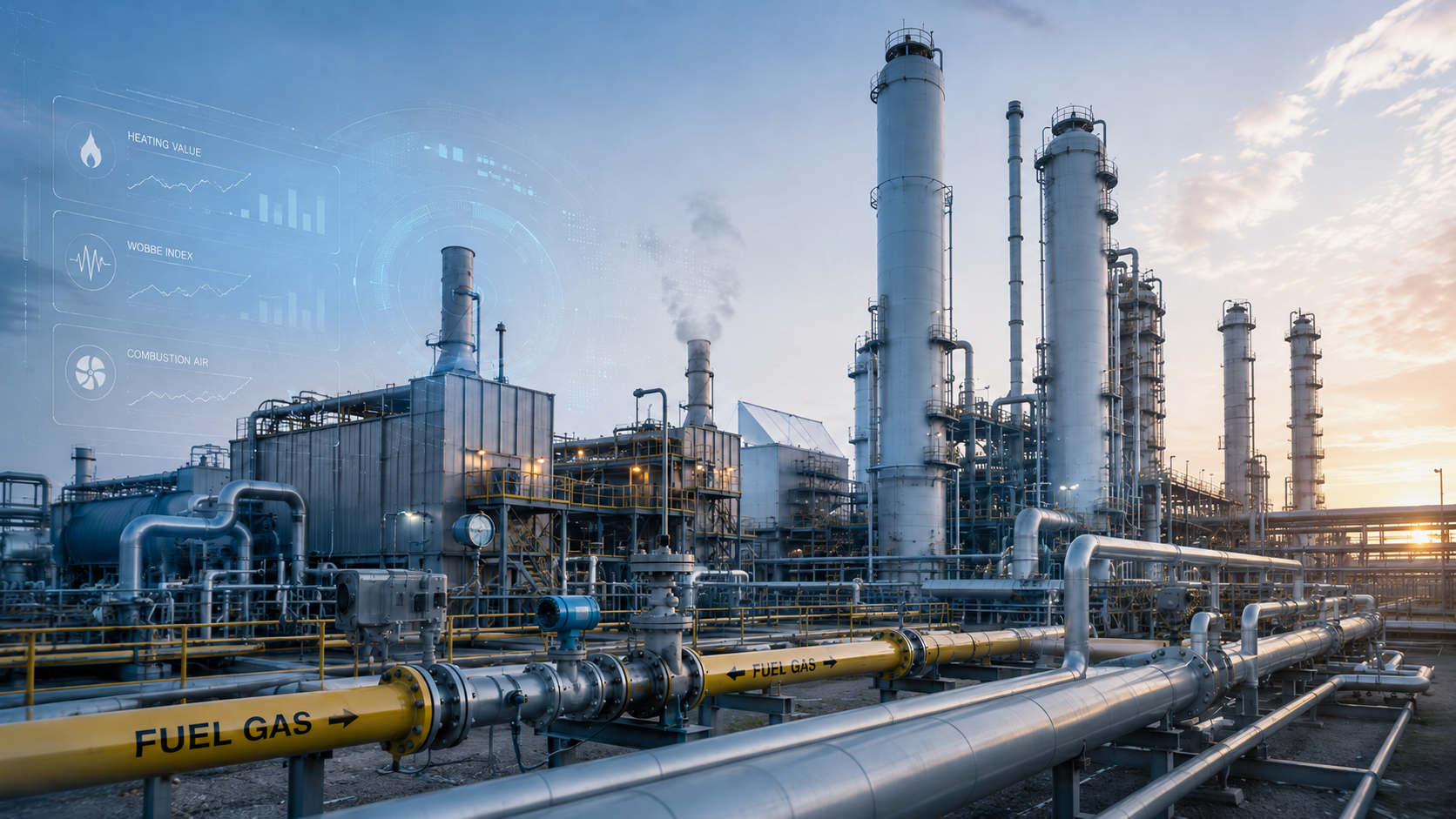
When planning a carbon capture and CO₂ quality project, much of the attention naturally falls on capture rate, CO₂ purity, compression and transportation.
For the engineers and operators responsible for keeping the facility running, however, the systems surrounding the capture process are equally important.
Carbon capture can increase demand for steam generation, process heating, compression and electrical power. Boilers, fired heaters, cogeneration units and other utility systems must continue delivering reliable energy as the facility’s operating requirements change.
That becomes more difficult when the fuel gas supplying those systems is not consistent.
A Consistent Fuel Gas Flow Does Not Always Deliver Consistent Energy
Plant and refinery fuel gas systems can receive gas from several process units. Changes in feedstock, operating conditions, hydrogen concentration, off-gas contributions or the availability of individual streams can alter the composition of the combined fuel.
As composition changes, so can:
- Heating value
- Specific gravity
- Wobbe Index
- Combustion air requirements
- Flame behaviour
- Burner heat input
A burner can therefore receive the same volumetric flow of gas while receiving a different amount of usable energy.
When combustion control is based primarily on gas flow or pressure, these changes may not be detected quickly. Operators may compensate by increasing fuel flow, maintaining excess combustion air or using wider operating margins to protect burner stability.
Those adjustments may keep the process running, but they can also increase fuel consumption and make the utility systems supporting carbon capture more difficult to control.
Why Fuel Gas Variability Matters to Carbon Capture
Carbon capture does not operate independently from the rest of the facility. It depends on supporting systems that must continue delivering stable steam, heat and power.
Steam generation
Many carbon capture processes require steam for solvent regeneration and other process duties.
If the heating value of the boiler fuel decreases, the same volume of fuel may produce less steam. If the heating value increases, the boiler may receive more energy than expected unless the control system adjusts accordingly.
Continuous fuel gas measurement helps operators separate a change in utility demand from a change in the fuel itself.
Fired heaters and process furnaces
Facilities implementing carbon capture may still rely on fired equipment for feed preparation, process heating and normal plant operation.
Changing fuel composition can affect furnace temperature, flame stability and burner performance. When the energy content of the gas changes without a corresponding adjustment, the heater may no longer deliver the intended heat input.
Thermal oxidizers and flare systems
Thermal oxidizers and flares may receive low-BTU or highly variable process gases. Operators need to understand whether those streams contain enough energy to maintain the required combustion conditions or whether supplemental fuel is necessary.
Continuous heating value measurement can help avoid both under-firing and unnecessary supplemental fuel use.
Cogeneration and utility systems
Some facilities generate both steam and electricity through boilers, gas turbines or cogeneration systems.
Changes in fuel quality can affect combustion performance, available heat and the balance between steam and power production. These effects can influence the wider utility network that the carbon capture process depends on.
Key Measurements for Fuel Gas and Combustion Control
Several measurements may be needed to understand how a changing fuel gas will behave in combustion equipment.
Heating value
Heating value indicates how much energy is available from a defined quantity of fuel.
For the operator, it answers a basic but essential question:
How much usable energy is being delivered to the burner?
When heating value falls, more fuel may be required to produce the same heat input. When it rises, maintaining the same flow may deliver more energy than expected.
Continuous heating value measurement allows control decisions to be based on the energy in the gas rather than assuming that every unit of volume is equivalent.
Wobbe Index
Wobbe Index relates the heating value of a gas to its specific gravity. It is used to evaluate how a fuel change may affect the heat delivered through the same burner orifice under similar supply conditions.
Two gases with different compositions may produce similar burner heat input when their Wobbe Index values are comparable. A significant change in Wobbe Index, however, can indicate that the gas may behave differently at the burner.
Monitoring Wobbe Index helps operators identify fuel changes that could affect burner performance even when pressure and volumetric flow remain stable.
Combustion air requirement
Different fuel compositions require different amounts of oxygen for complete combustion.
A fixed air-to-fuel setting may become less appropriate as composition changes:
- Too much air can carry additional heat out through the exhaust and reduce efficiency.
- Too little air can contribute to incomplete combustion, carbon monoxide formation and unstable burner operation.
Combustion Air Requirement Index, or CARI, provides information about the air required to combust the gas. Used alongside heating value and Wobbe Index, it provides a more complete understanding of both the energy delivered and the air required to use it effectively.
The Process Insights fuel gas application page provides additional information on the effects of composition swings, delayed measurement and incomplete fuel gas data.
Measurement response
A fuel gas measurement is most useful for control when it is available soon enough to influence the process.
Periodic laboratory testing can provide detailed and valuable information, but the result represents the gas at a particular point in time. If the fuel header changes between samples, operators may not see the variation until it has already affected combustion or steam production.
Continuous online measurement gives operators updated information while the change is occurring.
Flow Control and Energy Control Are Not the Same
Fuel flow remains an important part of combustion control, but flow alone does not account for changes in energy content.
Consider a boiler operating at a steady volumetric fuel gas flow:
- If heating value decreases, the boiler receives less energy.
- If heating value increases, the boiler receives more energy.
- If the combustion air setting remains fixed, the air-to-fuel relationship may move away from the intended operating point.
A flow-based strategy assumes that the fuel remains reasonably consistent.
That assumption may be appropriate for a stable pipeline-quality natural gas supply. It becomes less dependable when the facility uses refinery fuel gas, process off-gas, hydrogen-containing streams, biogas, blended fuels or other variable gas sources.
Adding continuous combustion-property measurement allows the control system to respond to what the fuel can actually deliver.
Comparing Fuel Gas Measurement Approaches
The appropriate measurement technology depends on what the facility needs to know, how quickly the gas can change and how the data will be used.
Laboratory analysis
Laboratory testing remains valuable for verification, troubleshooting and periodic quality assessment.
Its limitation for active combustion control is timing. Collecting, transporting and analyzing a sample can delay the result while the process continues to change.
Online gas chromatography
Online gas chromatography provides component-level composition data. Heating value, density and other calculated properties can then be determined from the measured composition.
This approach can be useful when operators require individual component concentrations in addition to combustion properties.
Direct calorimetric measurement
Continuous calorimetric measurement focuses directly on the combustion characteristics of the fuel, including heating value, Wobbe Index and combustion air requirement.
This approach can be useful when the primary objective is controlling boilers, burners, furnaces, turbines or flare systems rather than obtaining complete compositional information.
The 9610 CXc Continuous BTU Calorimeter is designed for continuous measurement of heating value, Wobbe Index and CARI in variable gaseous fuel streams. Process Insights positions the analyzer for real-time fuel quality and combustion-control applications involving burners, boilers, furnaces, turbines and flare systems.
Real-time compositional analysis
Some applications require more than the combustion properties of the fuel. Operators may also need concentrations of hydrogen, carbon dioxide, oxygen, hydrocarbons, nitrogen or trace contaminants.
The MAX300-RTG 2.0 Real-Time Gas Analyzer provides rapid, speciated composition measurement across a wide concentration range. It can also support applications where full-stream composition, calculated heating value and multiple measurement points are required.
The best approach is not necessarily the same at every measurement point. Some facilities use composition analysis for detailed process information and direct calorimetric measurement for fast combustion control.
Sample Transport Is Part of the Measurement
Analyzer response time alone does not determine how quickly a facility sees a process change.
The sample must first travel from the process connection to the analyzer. Long tubing runs, low sample flow, excessive internal volume and poorly designed conditioning components can add significant delay.
A fast analyzer connected to a slow sample system will still produce a slow process measurement.
For applications where rapid sample delivery is required, the Fast Sample System FSS-1 uses a compact, low-volume flow path designed to reduce sample lag while maintaining filtration and pressure control.
Distributing Samples to Multiple Analyzers
A single fuel gas stream may need to supply several analytical devices, validation points or grab-sampling connections.
The sample distribution system must maintain stable pressure, controlled flow and representative sample conditions for each connected device.
The Sample Distribution Panel SDP-1 provides dual-stage pressure regulation, inlet filtration and multiple sample outlets in a compact panel. It can be used to route a common gas source to online analyzers, grab sample points and other measurement devices.
Technical Factors to Review Before Selecting a System
Before selecting a fuel gas analyzer for a carbon capture application, the complete measurement point should be evaluated.
Expected fuel composition
Identify both normal and upset conditions, including expected concentrations of:
- Methane
- Hydrogen
- Carbon dioxide
- Nitrogen
- Heavier hydrocarbons
- Refinery or process off-gases
- Low-BTU components
- Sulfur compounds
The measurement system must be appropriate for the full expected range, not only normal operating conditions.
Required measurements
Determine whether the control strategy requires:
- Heating value
- Wobbe Index
- Combustion air requirement
- Specific gravity
- Hydrogen concentration
- Full component-level composition
This helps determine whether calorimetry, gas chromatography, mass spectrometry or another analytical technology is the best fit.
Required response time
Consider:
- How quickly the fuel composition can change
- How soon the control system must respond
- Distance from the sample point to the analyzer
- Sample-line volume
- Bypass flow
- Analyzer response
- Control-system update frequency
The overall system response is only as fast as its slowest part.
Sample conditioning
The sample system must deliver a clean, representative gas without introducing excessive delay or changing its composition.
Pressure reduction, temperature control, filtration, phase behaviour and sample-line design may be just as important as the analyzer itself.
Installation environment
Review:
- Hazardous-area classification
- Indoor or outdoor installation
- Ambient temperature range
- Available utilities
- Sample return or disposal requirements
- Maintenance access
- Communications with the control system
These conditions influence both analyzer selection and the design of the complete measurement system.
Validation and maintenance
A reliable measurement strategy should include a practical method for confirming analyzer response and identifying changes in system performance.
Calibration requirements, validation frequency, sample availability, consumables and technician access should be considered during the design stage rather than after commissioning.
Building Fuel Gas Measurement Into the Carbon Capture Strategy
Fuel gas measurement should be considered while designing or modifying the utility systems supporting carbon capture.
Useful questions include:
- Will the capture process increase steam or fired-heater demand?
- Which boilers, heaters or cogeneration units will provide that energy?
- Is the fuel supplied from a stable source or a variable plant header?
- Could hydrogen, carbon dioxide or process off-gases enter the fuel system?
- Is volumetric flow currently being used as a substitute for heat input?
- How quickly can composition change?
- Which measurement will be used to adjust the air-to-fuel ratio?
- How will analyzer response be validated?
- How quickly can the sample system deliver a process change to the analyzer?
Addressing these questions early helps avoid a common disconnect: designing the carbon capture process in detail while assuming the existing fuel and utility systems will continue behaving exactly as they did before.
Better Information for the Systems Carbon Capture Depends On
Carbon capture places considerable attention on the CO₂ stream, but reliable operation also depends on the heat, steam and power surrounding the process.
When fuel gas composition changes, flow alone may not show how much energy is reaching the burner or how much air is required to combust it.
Continuous measurement of heating value, Wobbe Index and combustion air requirement gives operators the information needed to respond to those changes. When full composition is also required, real-time compositional analysis can provide additional detail for process control and troubleshooting.
The objective is not simply to collect more analyzer data. It is to maintain consistent heat input, stable combustion and dependable utility performance as the facility’s operating demands change.utility performance as the facility’s operating demands change.
Planning Fuel Gas Measurement for a Carbon Capture Project?
The right measurement approach depends on more than the expected BTU range. Fuel composition, response time, sample transport, installation conditions, hazardous-area requirements and the intended control strategy all need to be considered together.
Insight Analytical can help evaluate the process stream, identify the measurements required and develop a complete analyzer and sample-conditioning solution for the application.
Discuss Your Fuel Gas Application
Related Measurement Solutions
9610 CXc Continuous BTU Calorimeter
Continuously measures heating value, Wobbe Index and Combustion Air Requirement Index for fuel gas, refinery gas, flare gas, hydrogen-containing streams and other variable gaseous fuels.
View the 9610 CXc Calorimeter
MAX300-RTG 2.0 Real-Time Gas Analyzer
Provides fast, complete gas composition data for carbon capture process monitoring, CO₂ quality control and applications where individual gas components must be measured in real time.
View the MAX300-RTG 2.0
Fast Sample System FSS-1
Reduces sample transport time between the process and analyzer, helping the analytical measurement respond quickly enough to support process and combustion control.
View the Fast Sample System FSS-1
Sample Distribution Panel
Routes a representative sample to multiple analyzers or sample points while maintaining controlled pressure, flow and sample integrity across the analytical system.
View the Sample Distribution Panel
Additional Technical Resources
For more information about fuel gas measurement technologies and applications, visit:
Process Insights Fuel Gas Applications
Process Insights 9610 CXc Technical Page
Explore Insight Analytical’s Carbon Capture and CO₂ Quality Solutions